Executive Summary
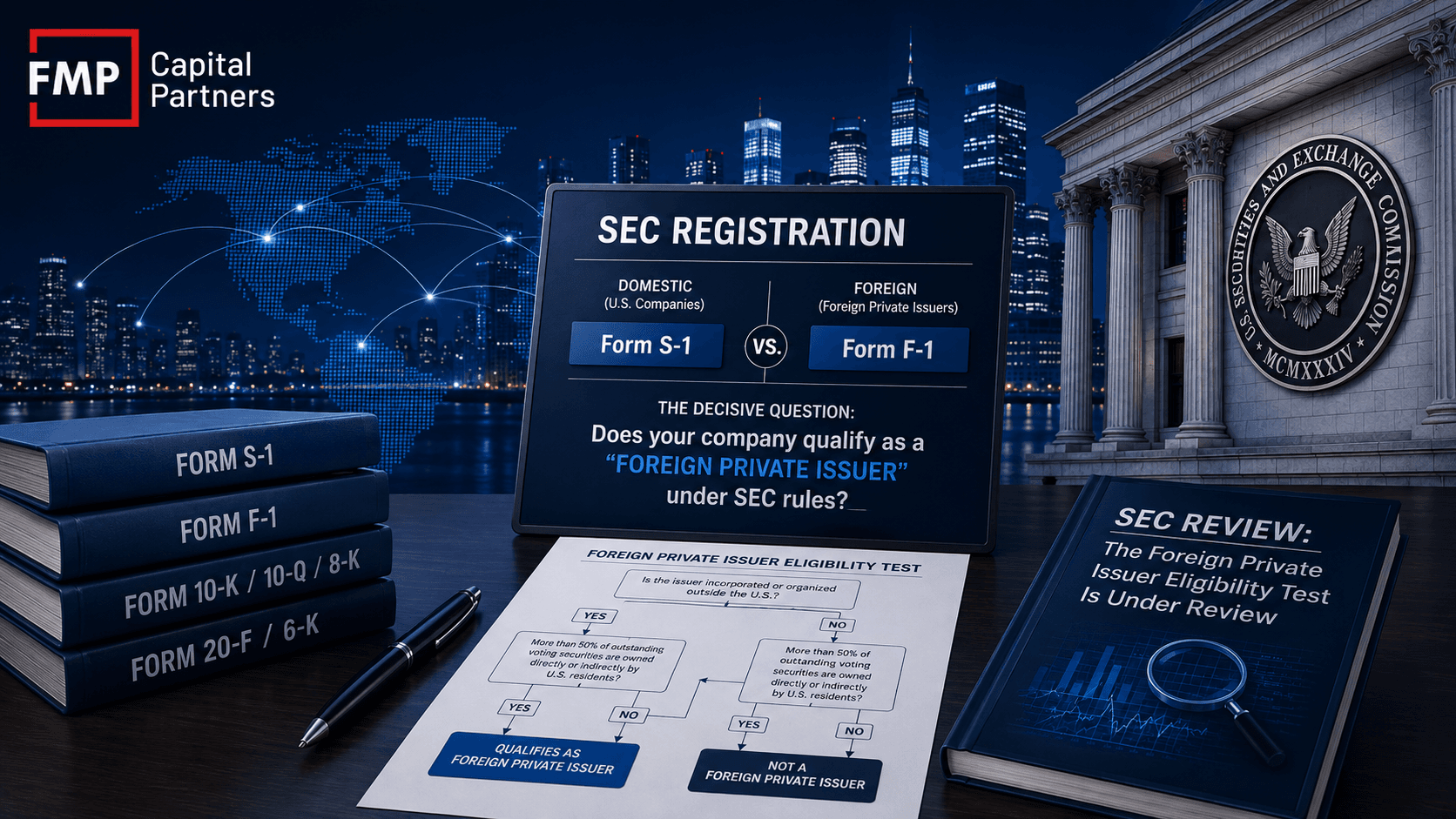
Most guides to SEC registration describe Form S-1 and Form F-1 as a simple choice: domestic companies file one, foreign companies file the other. In practice, the more consequential question comes first — does your company actually qualify as a "foreign private issuer" under SEC rules at all? That determination, not personal preference, decides which registration form applies, which accounting standards you may use, and which ongoing reporting regime — Form 10-K/10-Q/8-K or Form 20-F/6-K — governs the company after listing.
This guide explains all four forms in context, walks through the foreign private issuer eligibility test that most published guides skip, and flags a genuinely current development: the SEC is actively reviewing that eligibility test itself, which is directly relevant to any cross-border company planning its registration strategy today.
Introduction
Every company preparing a U.S. listing eventually files a registration statement under the Securities Act. Which form is correct is not a drafting-style choice — it is determined by the company's actual status, tested against specific SEC criteria, at a specific point in time. Getting this determination wrong early is expensive to unwind later, since it affects accounting standard selection, disclosure requirements, and the ongoing reporting regime for the life of the company as a public issuer.
Background
Two registration statements cover an initial U.S. listing of common stock: Form S-1, the default registration statement for domestic issuers, and Form F-1, the equivalent form for issuers that qualify as a foreign private issuer (FPI). Once listed, ongoing disclosure follows one of two parallel tracks: domestic issuers file periodic reports on Forms 10-K, 10-Q, and 8-K; foreign private issuers instead file an annual report on Form 20-F and furnish interim disclosures on Form 6-K.
The distinction matters beyond paperwork. FPIs filing Form 20-F may use home-country GAAP reconciled to U.S. GAAP, or IFRS as issued by the IASB without reconciliation — a meaningfully different accounting burden than the U.S. GAAP requirement domestic S-1/10-K filers face. Form 6-K disclosures are typically "furnished" rather than "filed," which carries a different legal liability standard than a "filed" domestic 8-K — a nuance many general guides omit entirely.
Strategic Analysis
The Real Threshold Question: Are You a Foreign Private Issuer?
Under SEC rules, a non-U.S. company qualifies as a foreign private issuer by satisfying either of two tests:
The Shareholder Test — 50% or less of the company's outstanding voting securities are held of record by U.S. residents.
The Business Contacts Test — if more than 50% of voting securities are U.S.-held, the company may still qualify as an FPI if none of the following applies: a majority of executive officers or directors are U.S. citizens or residents; more than 50% of assets are located in the United States; or the business is administered principally in the United States.
This determination is generally tested once per year, as of the last business day of the company's most recently completed second fiscal quarter — not on an ongoing, real-time basis. A company's FPI status at listing is not necessarily permanent; ownership shifts, board composition changes, or relocated operations can move a company across this threshold over time, with real consequences for which forms and accounting standards subsequently apply.
A Genuinely Current Development
As of this writing, the SEC has issued a concept release requesting public comment on potential changes to the foreign private issuer definition itself — including whether the current shareholder and business-contacts tests remain appropriate given how significantly the profile of FPI registrants has shifted since the definition was last substantively revisited. No rule change has been adopted as of publication. Companies planning a registration strategy around FPI status should treat the current test as the operative rule today, while confirming their status against the SEC's current guidance at the time of filing, given this is an active area of regulatory review rather than settled, static policy.
The Four Forms in Practical Terms
Form S-1 — Domestic Initial Registration
The default registration statement for U.S. domestic issuers conducting an initial public offering. Requires audited financial statements prepared under U.S. GAAP, business description, risk factors, use of proceeds, and management disclosure, with inline XBRL tagging of financial statements.
Form F-1 — Foreign Private Issuer Initial Registration
The equivalent registration statement for companies that qualify as an FPI. Cross-references Form 20-F for much of its specific disclosure content. Permits home-country GAAP reconciled to U.S. GAAP, or IFRS as issued by the IASB without reconciliation — a materially different accounting pathway than Form S-1 requires.
Form 20-F — Foreign Private Issuer Annual Report
The ongoing annual report FPIs file in place of Form 10-K, generally including audited financial statements for the prior three fiscal years. Functions as both an initial registration form in some contexts and the recurring annual disclosure vehicle after listing.
Form 6-K — Foreign Private Issuer Current Report
The FPI equivalent of a domestic Form 8-K, used to furnish material information between annual reports — earnings releases, material events, and information the company distributes to shareholders or its home-market regulator. Typically furnished rather than filed, a distinction with real legal-liability implications worth understanding before assuming it works identically to an 8-K.
Practical Considerations
Determine FPI status early and explicitly — as part of the readiness assessment described in our IPO readiness checklist, not as an assumption carried forward from how the company happens to think of itself. A company headquartered outside the United States is not automatically an FPI; the shareholder and business-contacts tests are specific, testable criteria, and a company with substantial U.S. ownership or U.S.-based leadership may not qualify despite being organized abroad.
Because the accounting standards permitted under Form F-1/20-F differ meaningfully from the U.S. GAAP required under Form S-1, this determination should inform the financial-statement audit work discussed in our IPO readiness checklist from the outset, not after audit work is already underway.
The determination also has a practical timing dimension worth planning around. Since FPI status is generally tested as of the last business day of the second fiscal quarter, a company approaching that date with ownership or governance changes in progress should resolve them, or at least understand their effect on the test, before that date arrives — retesting after the fact does not change which regime applied on the actual test date. Building this into the readiness timeline, rather than treating it as a detail to confirm closer to filing, avoids discovering late that the wrong accounting standard was assumed for months of audit work already completed.
Key Risks
Assuming FPI status without testing it — a foreign-organized company with substantial U.S. ownership or U.S.-based leadership may not actually qualify.
Treating FPI status as permanent — it is tested periodically, and changes in ownership or governance can shift a company's status after listing.
Underestimating Form 20-F's financial statement scope — three years of audited statements is a substantial undertaking for a company that has not previously operated under public-company audit standards.
Assuming "furnished" and "filed" carry the same legal weight — they do not, and the distinction affects Form 6-K's practical use.
Frequently Asked Questions
Can a company choose to file Form S-1 instead of Form F-1 even if it qualifies as an FPI?
Yes — FPI status determines eligibility for F-1/20-F/6-K, not an obligation to use them. Some companies that qualify as FPIs choose to file as a domestic issuer instead, generally because of specific disclosure, governance, or market-perception considerations. This is a strategic decision worth evaluating deliberately, not defaulting into either direction.
What happens if a company's FPI status changes after it has already listed using Form 20-F?
A company that no longer qualifies as an FPI must transition to domestic reporting requirements — Forms 10-K, 10-Q, and 8-K — following SEC transition rules. This is a real operational shift, not a formality, and is worth monitoring proactively rather than discovering at the next annual test date.
Does Form 20-F require the same financial statement detail as a domestic Form 10-K?
The scope is broadly comparable but not identical — Form 20-F's specific disclosure requirements, and the accounting standards permitted, differ from Form 10-K in ways that matter for cross-border companies particularly. This is an area worth confirming directly with securities counsel and auditors for your specific situation rather than assuming equivalence.
Is the foreign private issuer definition likely to change soon?
The SEC has requested public comment on the definition as of its current concept release, but no rule change has been adopted as of publication. Companies should plan around the current, operative test while watching for developments, rather than assuming either permanence or an imminent change in either direction.
Who should actually perform the foreign private issuer determination — the company, or its advisors?
Both, working together. The underlying facts — share ownership records, board composition, asset location, where the business is administered — sit with the company. Applying those facts correctly against the Shareholder Test and Business Contacts Test, and confirming the determination against current SEC guidance, is properly the role of securities counsel. Treating this as a form to fill out rather than a legal determination to reach with counsel is a common, avoidable source of downstream error.
Recommendations
Test FPI status explicitly and early, using the actual Shareholder Test and Business Contacts Test criteria, not an assumption based on where the company is headquartered. Build this determination into the readiness assessment and audit planning discussed in our IPO readiness checklist, since it affects which accounting standards apply from the start of the audit engagement, not just which form gets filed at the end. Confirm current SEC guidance on the foreign private issuer definition at the time of filing, given this is an active area of regulatory review.
Conclusion
The choice between Form S-1 and Form F-1 — and between ongoing 10-K/10-Q/8-K reporting versus 20-F/6-K reporting — is determined by a specific, testable eligibility question, not by geography or preference. Companies that resolve this determination early, and build it into their broader readiness planning, avoid the costly rework that comes from discovering the wrong accounting standard or disclosure framework was assumed from the outset.
Related reading: OTC vs. Nasdaq: Which U.S. Listing Path Is Right for Your Company?, IPO Readiness Checklist: 20 Critical Steps Before Going Public, and How Much Does It Cost to Go Public in the United States?. See also our IPO Advisory service.
Sources: U.S. Securities and Exchange Commission — Forms Index. Verified against this primary source August 10, 2026.
About FMP Capital Partners
FMP Capital Partners advises growth companies on U.S. capital markets, including SEC readiness, Nasdaq and OTC Markets listings, corporate governance, regulatory compliance, cross-border transactions, and capital raising strategies. Our objective is to help companies navigate complex regulatory environments while building long-term shareholder value.