Executive Summary
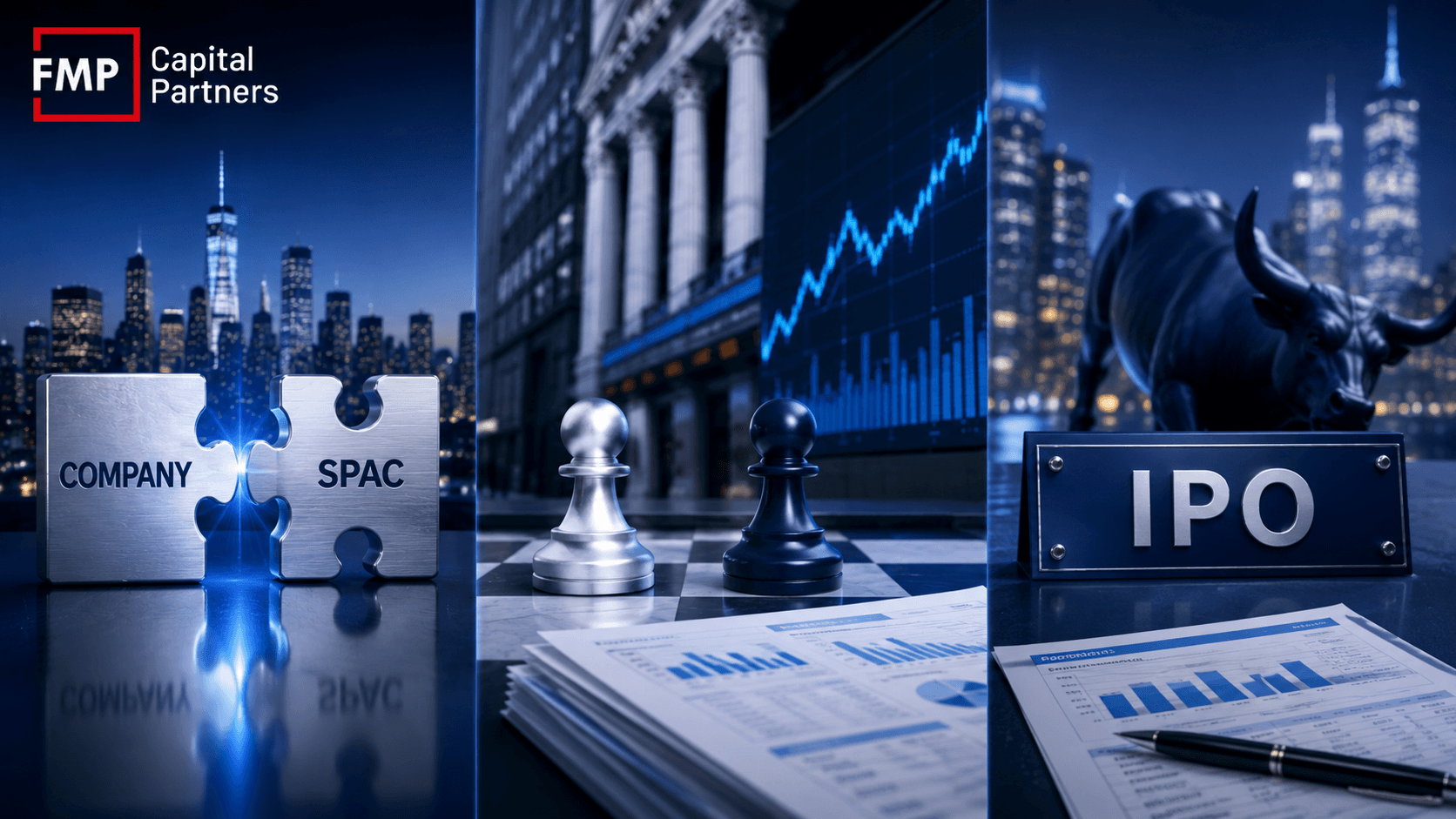
"Going public" and "doing an IPO" are treated as the same thing, and increasingly they are not. In 2025, 202 companies completed traditional underwritten IPOs, raising $44.0 billion. Alongside them, roughly 133 companies went public through a SPAC merger — a path that does not involve an IPO of the operating company at all. Combined, SPAC transactions accounted for more than a third of all U.S. companies that went public in 2025, and the pipeline is not slowing down: over 200 private companies have expressed interest in a SPAC merger heading into 2026, with more than 100 business combinations already announced. A reverse merger with a non-SPAC shell adds a third path entirely, and Nasdaq just changed the rules governing how it is treated relative to a de-SPAC. This article explains what each path actually is, how they differ in speed, cost, dilution, and regulatory treatment, and how to choose deliberately rather than by default.
Introduction
Most executives use "IPO" as shorthand for "becoming a public company," but a traditional underwritten initial public offering is only one of three distinct legal routes to a public listing, and it is often not the fastest or least dilutive one. A SPAC merger (a "de-SPAC") takes a private operating company public by merging it into an already-public shell company that raised capital specifically to make an acquisition. A reverse merger with a non-SPAC shell does something structurally similar but without the trust-account capital or the specific regulatory framework SPACs now operate under. Each path has real, current tradeoffs — and as of December 2025, Nasdaq has formally recognized that a de-SPAC and a reverse merger are not the same thing, changing how each is regulated going forward.
This matters most for companies weighing timeline against dilution, and for companies that assumed a traditional IPO — with the 12-to-24-month build described in How Much Does It Cost to Go Public in the United States? — was their only route to Nasdaq or the NYSE. It frequently is not.
Background
All three paths end in the same place — a publicly traded company — but get there through structurally different transactions:
| Path | Mechanism | Typical Timeline | New Capital Raised |
|---|---|---|---|
| Traditional IPO | Underwritten public offering of new shares (Form S-1/F-1) | 12–24 months | Yes — primary capital from the offering |
| SPAC merger (de-SPAC) | Merger into an already-public shell that raised capital via its own SPAC IPO (Form S-4/F-4) | Months from signed letter of intent to closing, after the SPAC has already found a target | Yes — from the SPAC's trust account plus any PIPE financing arranged alongside the merger |
| Reverse merger (non-SPAC shell) | Merger into an existing public or formerly public shell company | 3–6 months, sometimes faster | No — the shell itself typically has no meaningful trust capital |
A SPAC (special purpose acquisition company) is a shell company that completes its own IPO first, raising capital from public investors that is placed in a trust account earning interest while the SPAC's sponsors search for a private company to acquire — typically within a two-year window. Sponsors receive "founder shares" for a nominal amount, historically representing roughly 20% of the SPAC's post-IPO equity (the "promote"); 2026 market reforms have pushed newer deals toward a smaller, more performance-linked 10–15% structure, and warrant dilution on new issuances has declined 50–75% from the peak SPAC era. When the SPAC completes its merger with a target — the de-SPAC — the target company becomes the public entity, inheriting the trust account's cash (net of redemptions) and often raising additional capital through a simultaneous PIPE (private investment in public equity).
A reverse merger with a non-SPAC shell follows an older, simpler structure: a private operating company merges into an existing public shell — often a company with a listing but no meaningful ongoing business — and the private company's shareholders end up controlling the combined public entity. There is generally no trust account and no built-in capital raise; the primary benefit is the public listing itself, with any capital raised as a separate, subsequent transaction. Because this structure has historically been used to bypass IPO-level scrutiny, Nasdaq's "seasoning rule" requires a company formed by a reverse merger to trade for at least one year in the U.S. OTC market or on a regulated exchange, sustain a minimum $4 closing price for 30 of the most recent 60 trading days, and have at least one annual report with audited financials on file before it can apply for listing — with four annual reports required before the seasoning requirement fully expires. A company that instead completes a firm-commitment underwritten offering raising at least $40 million in gross proceeds can bypass the seasoning requirement entirely.
Until December 2025, de-SPAC transactions by certain OTC-trading SPACs risked being swept into this same reverse-merger seasoning framework. Nasdaq's rule change (SR-NASDAQ-2025-066, approved by the SEC in December 2025) formally excludes de-SPACs by listed and formerly-listed OTC-trading SPACs from the definition of "reverse merger" and removes a related average-daily-volume requirement that previously applied. The stated rationale: a de-SPAC more closely resembles an IPO of the target company than a reverse merger, and Nasdaq's newer SPAC-specific listing and disclosure rules already provide the investor protections the reverse-merger framework was designed to ensure. In practice, this means a well-structured de-SPAC now has a materially clearer regulatory path than a comparable non-SPAC reverse merger — the two are no longer treated as interchangeable.
Strategic Analysis: Why the Choice Is About Tradeoffs, Not a Single Best Path
Each path optimizes for a different constraint, and the right choice depends on what a company actually needs:
- Traditional IPO — best when the company can absorb the timeline and wants the cleanest governance and disclosure history. A traditional IPO builds a public trading and reporting history from day one, with underwriters providing price discovery and a distribution network. It is also the most expensive and slowest path, and — per How Much Does It Cost to Go Public in the United States? — requires the full governance and audit build-out described in IPO Readiness Checklist: 20 Critical Steps Before Going Public before a company can credibly file.
- SPAC merger — best when speed and valuation certainty matter more than avoiding dilution. Because the SPAC has already raised and holds capital in trust, a de-SPAC can close faster than a traditional IPO once a target is identified, and the merger price is negotiated directly rather than subject to a roadshow's market timing risk. The tradeoff is the sponsor promote and warrant dilution, redemption risk (public SPAC shareholders can redeem their shares for cash rather than roll into the merger, reducing the capital actually available at closing), and a target company that inherits an already-public shareholder base it did not choose.
- Reverse merger — best for a fast, low-cost path to a public listing when new capital isn't the immediate priority. Without a trust account or underwriting process, a reverse merger is typically the fastest and least expensive route to public status. It raises no new capital on its own, and — outside the narrower de-SPAC carve-out — remains subject to the full seasoning rule, meaning genuine uplisting to Nasdaq or NYSE is delayed regardless of how quickly the merger itself closes.
None of these paths eliminates the underlying work. A target company entering a de-SPAC still needs institutional-grade financial statements, audit readiness, and governance — the same substance covered in IPO Readiness Checklist: 20 Critical Steps Before Going Public — because the combined company inherits full reporting obligations at closing, not gradually. A de-SPAC merger is registered on Form S-4 or F-4 rather than the S-1/F-1 track used for a traditional IPO, covered alongside the other SEC registration forms in Understanding SEC Registration: S-1, F-1, 20-F and 6-K Explained, but the underlying disclosure and audit standard does not get lighter because the form changed.
Practical Considerations
- Match the path to what actually constrains the company — time, dilution, or governance readiness — not to which path is most talked about. A SPAC boom in the market doesn't make a de-SPAC the right structure for every company; it makes more SPAC sponsors available to negotiate with.
- Diligence the SPAC as carefully as the SPAC diligences the target. Sponsor track record, trust account size relative to redemption risk, remaining time before the SPAC's deadline, and existing PIPE relationships all materially affect whether a signed letter of intent actually closes with the capital the company expected.
- Model redemptions explicitly. Public SPAC shareholders redeeming their shares for cash at closing is common and can leave a de-SPAC company with materially less cash than the SPAC's trust balance suggested — plan the combined company's capital needs assuming a meaningful redemption rate, not a best case.
- If considering a non-SPAC reverse merger, confirm the seasoning timeline before committing. A reverse merger can close quickly, but genuine Nasdaq or NYSE listing eligibility is still gated by the one-year seasoning requirement (or the $40 million firm-commitment underwriting exception) — know which timeline actually applies before treating the merger date as the finish line.
- Build governance and audit readiness on the traditional-IPO timeline regardless of which path is chosen. A de-SPAC or reverse merger compresses the transaction timeline, not the underlying institutional build a public company requires — see IPO Readiness Checklist: 20 Critical Steps Before Going Public.
- Weigh private placement as a genuine fourth alternative. If the real goal is capital rather than a public listing itself, The Faster, Simpler Way to Raise Capital in the U.S. — Without Going Public may be a faster path to the same underlying need.
Key Risks
- Redemption risk. High redemption rates at a de-SPAC's closing can leave far less cash than the headline trust value implies, sometimes forcing a company to raise a larger PIPE than planned or close with a materially weaker balance sheet.
- Sponsor misalignment. The SPAC promote structure has historically rewarded sponsors for closing any deal within their deadline, regardless of valuation quality — diligence the sponsor's incentives, not just their track record.
- Underestimating post-closing reporting obligations. Both a de-SPAC and a reverse merger can close faster than a traditional IPO, but the combined company inherits full public-company reporting obligations immediately at closing — there is no gradual on-ramp.
- Reverse-merger seasoning risk. Outside the narrow de-SPAC carve-out, a reverse merger into a shell does not itself confer Nasdaq or NYSE listing eligibility — companies that treat the merger closing as equivalent to an exchange listing risk a real gap between "public" and "listed."
- Regulatory timing risk. Nasdaq's December 2025 rule change shows this framework is still actively evolving — a multi-year plan built around today's specific rules should build in margin for further change, similar to the regulatory-timing risk described for foreign issuers in Why Most International Companies Never Make It to Nasdaq.
Recommendations
- Choose the path based on what actually constrains the company — timeline, dilution tolerance, or governance readiness — not market sentiment about which structure is fashionable.
- For a SPAC merger, diligence the sponsor and model redemption scenarios explicitly before signing a letter of intent.
- For a reverse merger, confirm whether the one-year seasoning requirement or the $40 million underwriting exception applies before treating the transaction as complete.
- Build institutional-grade governance, audit readiness, and financial reporting on the same timeline a traditional IPO would require, regardless of which path is chosen.
- Engage securities counsel early to determine whether Nasdaq's current de-SPAC treatment (post-December 2025) applies to the specific transaction structure under consideration.
- Compare all three public-listing paths against private placement as a fourth option before assuming a public listing is the objective at all.
Frequently Asked Questions
What's the real difference between a SPAC merger and a traditional IPO?
A traditional IPO is a new underwritten offering of the operating company's own shares. A SPAC merger takes the operating company public by merging it into an already-public shell company that raised capital in its own prior IPO — the operating company itself never files or prices a traditional IPO.
Is a reverse merger the same thing as a SPAC merger?
No. Both involve merging into a public shell, but a SPAC is a purpose-built vehicle with trust-account capital and its own regulatory framework. A non-SPAC reverse merger uses an existing shell with typically no meaningful capital, and — outside a narrow December 2025 carve-out for de-SPACs — remains subject to Nasdaq's one-year seasoning requirement before genuine exchange listing eligibility.
How many companies went public via SPAC in 2025?
Approximately 133 SPAC IPOs priced in 2025, raising more than $20 billion, alongside 202 traditional IPOs raising $44.0 billion — meaning SPAC transactions accounted for more than a third of all U.S. companies that went public that year.
Does a de-SPAC merger raise new capital for the company?
Yes, but the amount depends heavily on redemptions. The company receives the SPAC's trust account cash net of any shareholder redemptions, often supplemented by a PIPE arranged alongside the merger — the actual capital received can be materially lower than the SPAC's headline trust balance.
Which path is fastest?
A non-SPAC reverse merger is typically the fastest way to become technically public, often 3 to 6 months. A de-SPAC can close within months once a target is identified, though finding that target can itself take considerable time. A traditional IPO realistically takes 12 to 24 months from the start of formal preparation.
Conclusion
More than a third of the U.S. companies that went public in 2025 did not do a traditional IPO — they used a SPAC merger, and the pipeline heading into 2026 suggests that share is not shrinking. A reverse merger with a non-SPAC shell adds a third structurally distinct path, now regulated differently from a de-SPAC following Nasdaq's December 2025 rule change. None of these paths is objectively superior; each trades timeline, dilution, and regulatory certainty differently, and the right choice depends on what actually constrains a specific company. What doesn't change across any of the three paths is the underlying institutional readiness a public company requires — the transaction structure determines how fast a company can close, not whether it is genuinely ready to operate as one.
Sources: Nasdaq Rule Change SR-NASDAQ-2025-066 (SEC-approved December 2025), corroborated by Securities Law Blog and Lexology coverage of the amendment; original Nasdaq/NYSE reverse-merger seasoning rule requirements; 2025 U.S. IPO and SPAC IPO activity from Renaissance Capital's 2025 US IPO Market Review and SPAC IPO tracker. Verified against these sources August 16, 2026.
About FMP Capital Partners
Weighing a traditional IPO against a SPAC merger or reverse merger? FMP Capital Partners advises growth companies on Nasdaq and OTC listings, SPAC and reverse merger transactions, SEC readiness, and capital raising. Contact our advisory team for a confidential discussion regarding your capital markets strategy.